
Contact us
RECEPTION
+4 0724 003 658
reservations@zabola.com
EVENT MANAGER
Mrs. Imola Gazda
+4 0722 180 152
events@zabola.com
Bears and birds in Europe’s wild heart

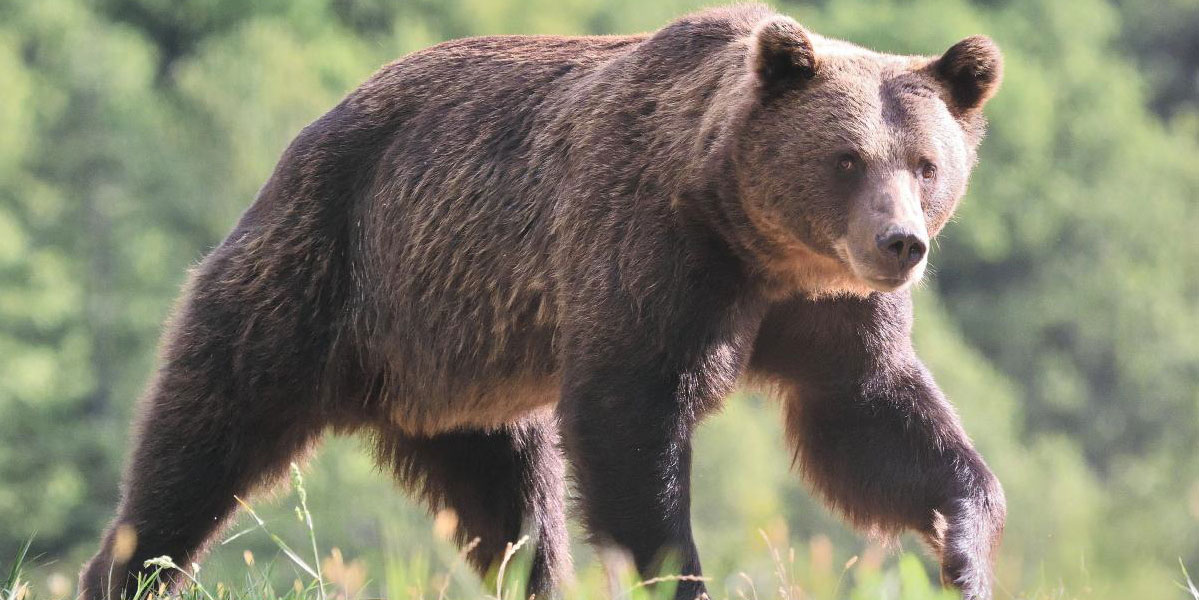
A recent trip to Romania’s Carpathian Mountains was filled with astonishing mammal encounters and special birds for David Campbell.
The Carpathians were an imposing border to the landscape when we pitched down at Brasov airport on a Sunday evening in September, nature looming large over a refreshingly insignificant patch of concrete. There was no time for anything except gathering the group together onto a minibus, setting o! into Transylvania as dusk fell, and grabbing some light nibbles with the Count. Waking up ahead of the others for a stroll around the grounds of the Zabola Estate, I knew I was somewhere wilder than I am accustomed to, despite the stately buildings nestled among the trees. Grey-headed Woodpeckers gave their wry laugh from a layer or two back, then one appeared motionless against the skyline; it was only the second time I have seen this species and I made sure to savour the moment.
While Count Gregor Roy Chowdhury-Mikes, who manages the family estate, showed us its equestrian facilities, spa rooms and garden kitchen, I had to react just enough whenever the likes of a Wood Warbler, European Honey Buzzard, Black Redstart or Eurasian Goshawk suddenly appeared. Our group included journalists of all flavours; several were keen to see birds, so I needed to alert them without interrupting the Count’s flow.
Zabola is truly a fascinating destination. O!ering luxury with a gothic touch and a low-impact philosophy, the Mikes family has lived in and operated the estate for more than six centuries, the communist era bringing the only interruption. Today, ecotourism has become central to what they do, Zabola being perfectly suited for those who wish to immerse in nature while simultaneously supporting local people and wildlife conservation.
Luxury meets low-impact
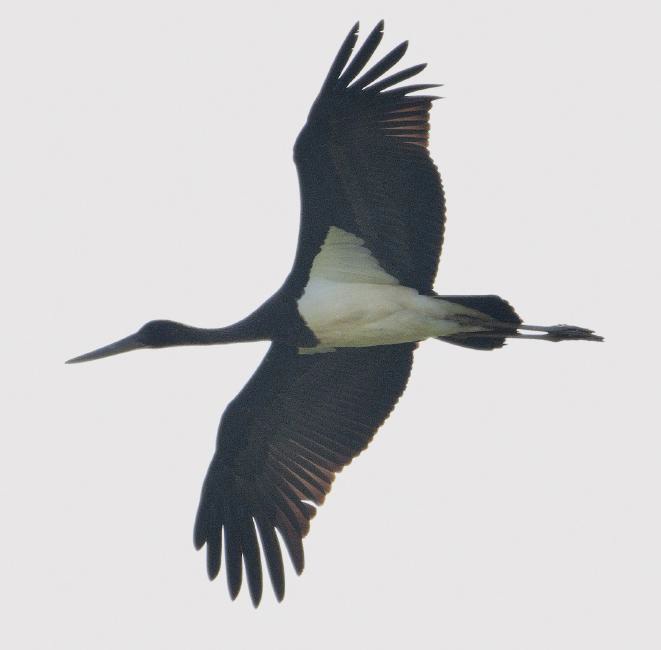
The secretive Black Stork breeds in the Carpathian Mountains, nesting in undisturbed forested areas and foraging in nearby shallow waters. The Carpathians are part of the species’ extensive summer breeding range across eastern Europe.
A horse-and-cart ride to visit a local barrel-maker delivered sightings of Lesser Spotted Eagle, Red-footed Falcon, Red-backed Shrike and Great Grey Shrike. We were surrounded by distant mountains again, in an agricultural patchwork of maize, wheat, orchards, hay meadows and traditional grazing. Although farming is modernising in Romania, horse-drawn equipment is still used, chemicals are only sprayed occasionally, and the fields are smaller with more inviting borders.
After lunch back at Zabola, we gathered outside the dining room in preparation for our trip to the bear hide. A juvenile Black Stork broke the treeline, and multi-award-winning wildlife photographer Bence Máté came around the corner with ‘bearwhisperer’ Péter Levente. Back at school, I used to while away computer classes by sneaking looks at Máté’s website, when I was meant to be trying out Excel formulas. Crossing paths with him was an unexpected treat for me. We jumped into four-wheel drives to reach the hide, nestled into the ground, which Máté had designed and built in collaboration with the Zabola Estate.
Complete with Máté’s innovative one-way glass (animals cannot see the observers inside the hide, only their own reflection and that of the surrounding landscape), all we needed to do to remain undetectable was keep our voices down.The clearing was empty, and it felt as though it might remain so. I just couldn’t imagine anything emerging from the forest; I sometimes feel like I’ve grown a sense for when wildlife is or isn’t going to appear.
When this is taking a pessimistic stance, it’s nice to be proven wrong. I maintained enough faith to keep my eyes scanning the edge of the clearing. If a bear appeared, I had a childish urge to spot it first, to have the thrill of my first encounter that bit more raw and personal. A flock of Cha!nches took to the corn that Levente had scattered before we began our stakeout, but for once I was crossing my fingers a mammal would come in to crash their party.
Bear encounter of the close kind
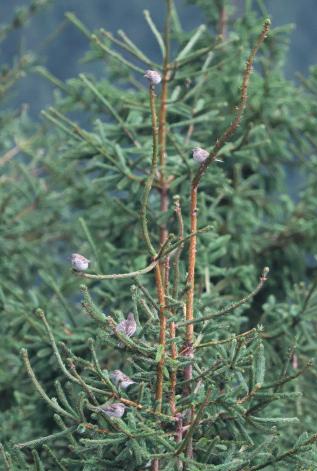
Large post-breeding flocks of Water Pipits were seen at the Comisu shepherd hut, with groups often perched up together.
I struggled to keep my voice down when my eyes registered a huge animal confidently enter the arena. My first wild Brown Bear was within 50 m of me, now methodically working through the lines of corn and plodding ever closer: lumbering yet powerful, a little dog-like but with a presence that made me acutely aware of my own breathing. During the course of our twohours in the hide, a total of five Brown Bears came and went, with two sharing the pickings with a ballsy Wild Boar for some time.
When all had gone, I climbed back up the stairs into the open air feeling like a slightly di”erent person, in a similar way to when I saw my first whale, my first elephant, and my first albatross. I had always longed to be present in an intact ecosystem in Europe, with its megafauna roaming the forest it sculpts, as it would have been in Britain countless generations ago. It was more of an enriching human experience than I could have imagined.
The next morning, I said goodbye to Zabola with another stroll through its grounds, adding Middle Spotted Woodpecker and some migrating Western Marsh Harriers to the trip list, before the drive to Equus Silvania. There we met Barbara and Christoph Promberger, originally from Germany and Austria respectively, the co-founders of Foundation Conservation Carpathia (FCC). The Prombergers’ ultimate goal is to create a new national park in the Fagaras Mountains, which they see as Europe’s answer to Yellowstone. The foundation has already purchased 26,000 ha, which is now under full protection. With all 10 of Europe’s woodpecker species on their doorstep, and large mammals such as bears, wolves, lynx and bison roaming the slopes, the nature is already there. The foundation’s key challenge is getting local communities onboard with the idea to form a park of up to 250,000 ha, which they have been making steady progress with.
Equus Silvania is Barbara and Christoph’s riding centre and guest house, nestled in the peaceful village of Sinca Noua. It is part of Travel Carpathia, the ecotourism arm of FCC, and has brought in plenty of horse-riders looking for an experience among natural beauty. However, the accommodation increasingly hosts birders and wildlife-watchers keen to seek out the unique assemblage of species in the area.
Into the woods
Christoph took us on a tour of virgin forest trails in the Stramba Valley, where we heard Black Woodpecker and saw evidence of their heavy-duty excavations close to ground level. The tallest known fir in Europe, measuring 62.5 m, towered above a pristine woodland where trees had always lived, died and supported the life cycles of countless species. Ural Owl and White-backed Woodpecker are among the enticing bird species present in the area. After a luxurious night’s sleep, our hiking guide Oana led us on a 6-km trek to our next accommodation. We stopped frequently to admire the rich array of fungi, but usually a Willow Tit (a species I haven’t seen in Britain for nine years) or Crested Tit distracted me in the trees above. Keeping my eyes on the stream alongside the trail paid o! with an encounter with a Dipper.
Had we not had to keep moving as dusk approached and we clocked up an ascent of over 600 m, we would have had a very good shot at Eurasian Pygmy Owls in the sweet-scented stands of aged Norway Spruce. The high clearing in which the Comisu shepherd hut sits was a hit with Water Pipits, with postbreeding flocks erupting from the grass and seemingly checking us out from the woodpile by the door. The hut shares the clearing with a dedicated wildlife hide, with the jagged limestone ridge of the Piatra Craiului Mountains occasionally revealed by the clouds in the far distance.
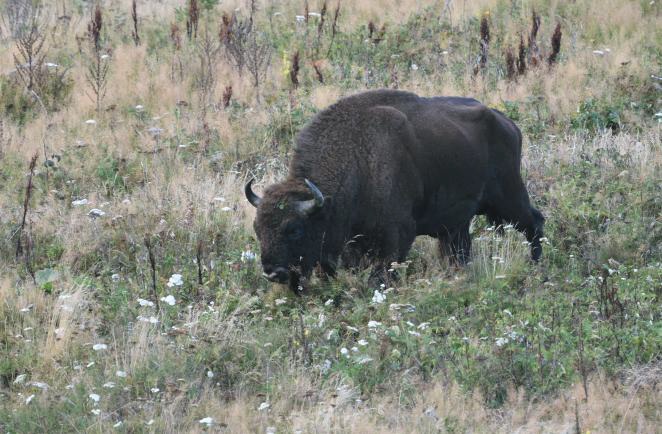
European Bison are being successfully reintroduced to the Carpathian Mountains in Romania, specifically in the Southern Carpathians rewilding landscape. This reintroduction is a long-term effort by organisations including Rewilding Europe and WWF Romania.
Visits are only possible in the company of a guide due to the potential dangers of crossing paths with large mammals. Unlike the bear hide at Zabola the area overlooked by the hide is not baited, so wildlife experiences are much further from guaranteed, but the Prombergers believe they feel all the more special when luck does strike. Accordingly, we put in a long afternoon stint scanning the clearing from the comfort of the hide. Oana taunted me with her story of a Ural Owl alighting in front of her on a previous visit. This time, nothing appeared by the time dinner called. Fellow journalist James joined me for a morning co!ee on the hut’s veranda.
While I updated him on the bird sightings of the first few minutes of the day, he asked: “And what’s that!?” A literal stone’s throw from where we were standing, a bull European Bison was calmly grazing behind what I now knew as the ‘Water Pipit woodpile’. Somehow, I had totally overlooked this huge bovid that was practically under my nose! The alert went out and the whole party was out of bed, breakfasting with the bison. It sauntered downslope towards the hide to lick some salt for another hour or so, before vanishing back into the trees.
Bison brought back
FCC’s European Bison reintroduction project completed its final releases in the spring of 2024, bringing the total released between 2020 and 2024 to 81 animals. The bison have taken well to life in the Carpathians, with 12 calves born in 2024. As a keystone species, which was driven to extinction in Romania by 1790, bison o!er the chance to boost biodiversity and the local economy, as well as helping combat climate change.
I was bursting to go walking in the woods but a Northern Nutcracker, only my second observation of the species, topped o! a veranda watch that also featured Ring Ouzel and a flock of Crossbills. A hike, an electric raft crossing of Lacul Pecineagu and another hike later, we reached the Poiana Tamas Wilderness Camp.
Poiana Tamas is a glamping site like no other. Like Comisu, visitors need to be accompanied by a guide, with wildlife-watching excursions available as part of a stay there.
As we entered the site, Oana spotted the scat of a Eurasian Lynx at the base of a tree. The tangle of Roe Deer fur was the giveaway. We then heard from the sta! at the site that likely the same animal appeared on their camera trap along a nearby woodland track the previous night. Over the fire, it was settled: we would search for the cat, and any owls in the area, at dusk.
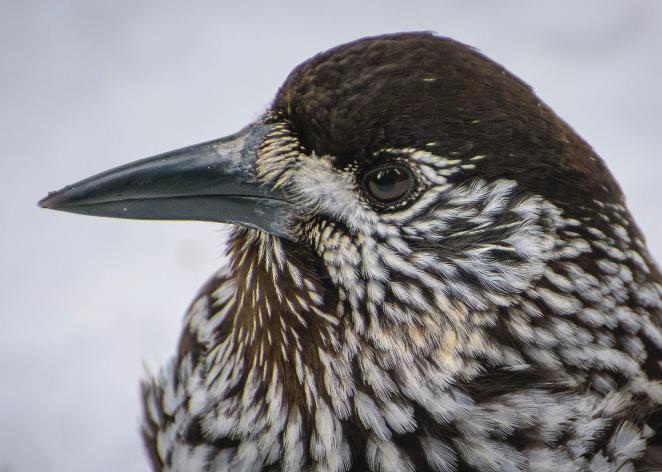
David enjoyed two encounters with Northern Nutcracker while in Romania. This is a particularly desirable species and one that can be unpredictable and tricky to see.
It was fortunate that we were all assembled, as one of the camp staff peered in with a huge grin to say that a herd of bison had come to visit. There was a mad scramble as we grabbed our cameras and headed to the fence, safely enclosing us while the animals roamed free, to take in the sight of a dozen of these hench ecosystem engineers working their way, one mouthful of grass at a time, down the hill. Two particularly endearing animals were this year’s young, very leggy and yet to grow full horns or the full woolly layers around their head and shoulders.
Once they had moved on, we set out to the sound of bellowing Red Deer all around. Scanning with my thermal imager, I spotted scattered stags between the trees. The lynx eluded us in life, but we saw its image for ourselves on the back of the camera trap, along with a suite of other animals that had commuted along the same ride, including Brown Bear and European Wildcat. I couldn’t resist a sweep of the camp after dark, adding Brown Hare to the mammal list.
A visit to Dracula’s Castle
Time in the field was limited on the last day of our adventure, but I enjoyed further encounters with Northern Nutcracker and Crested Tit, as well as calling into the innovative Beaver’s House visitor centre in Rucar. This is the first of several naturethemed visitor centres built with and situated within local communities. We also saw first-hand the habitat created by beavers at a roadside wetland, following a successful translocation project by FCC.
It would have been poor form to visit Transylvania without calling in at Bran Castle, branded as ‘Dracula’s Castle’, and the final hours of the trip were well-spent in the lively and stunning old town in Brasov, where we had a chance for second helpings of Romanian delights such as chimney cake and biscuit salami while Black Redstarts sang from the rooftops.
I was left longing for more time exploring the Carpathians. My visit was not at an ideal time for birding, but I had come away with memorable sightings of several species I’d rarely seen before, while experiencing intact ecosystems, incredible scenery and fascinating local culture.
The Carpathians o!er birders the unique opportunity to see species that are more usually sought out in Fennoscandia, such as Eurasian Pygmy Owl, Hazel Grouse and the whole range of woodpeckers. They are home to underappreciated forms such as macroura Ural Owl and alpinus Eurasian Three-toed Woodpecker.
On top of this, there is the chance to track down species you wouldn’t find in countries such as Finland: Alpine Accentor, Wallcreeper and Sombre Tit, to name just a few. What’s more, plans are afoot to reintroduce three species of vulture to the mountains, with Gri!on, Cinereous and Bearded Vultures, lost by the early 20th century, representing some of the missing keystone species (but not for long!).
Add in the incredible mammal experiences on o!er in the Carpathians, and ‘Europe’s Yellowstone’ feels like an understatement for flagship ranges such as the Fagaras Mountains.
A trip to the mountains could be extended to spend a few days in the Danube Delta, where Dalmatian Pelicans and Pygmy Cormorants thrive among over 300 other bird species, making for a potentially unbeatable European birding adventure.
Repost from: www.birdguides.com