
Contact us
RECEPTION
+4 0724 003 658
reservations@zabola.com
EVENT MANAGER
Mrs. Imola Gazda
+4 0722 180 152
events@zabola.com
Between bear and man

At first, it’s just a shadow flitting past the beech and silver fir trees at At the edge of the clearing. But then the animal’s contours become clear against the contrast of the low afternoon sun. Finally: a brown bear. A brief moment of excitement among the guests in the low wooden hut, then silence […]
At first, it’s just a shadow flitting past the beech and silver fir trees at At the edge of the clearing. But then the animal’s contours become clear against the contrast of the low afternoon sun. Finally: a brown bear. A brief moment of excitement among the guests in the low wooden hut, then silence – because the bear is only about ten meters away and shouldn’t hear us. This special observation hide in the forest of the Zabola estate in Romania, just under 70 kilometers from the city of Braşov – once known as the Transylvanian Kronstadt – is built precisely for this purpose: half-buried in the ground and barely visible from the outside. Inside, it’s cool and smells of earth. Bear whisperer Levente Péter hasn’t exaggerated. The Romanian ranger works for Conservation Transylvania. The non-profit foundation surrounding the Zabola estate names the bears of the area, offers them corn, and explains the lives of wild animals to visitors “Every day I put food out here, and it’s always eaten. I don’t know the exact time, but the bears always come eventually,” Péter promises.
So does Anna the bear, who now vigilantly circles the small meadow, sniffing at the corn that’s been put out. She’s alone because, “Mothers with cubs don’t come here,” Péter whispers. “It’s too open. If large males appear, it becomes dangerous. The cubs can climb trees in a flash, but there’s no protection in this clearing.” Male bears sometimes kill a rival’s offspring to bring the mother back into fertility more quickly.
“Blondie,”says Péter. The almost 20-year-old brown bear goes to the small pond, lowers himself into the water, and vigorously shakes his light brown fur after his bath. Drops spray like sparks in the backlight, while the female bear Anna gives him a wide berth-a silent confirmation of Péter’s words about caution towards rivals.
Levente Péter grew up in this area. “Even before I met my wife, I did this because I love the forest. I won’t give it up for anyone.” Friends and family simply call him “Bear-man.” For him, the observation cabin is a suitable tool to change people’s attitudes. “That’s why we built it. Ialso bring people from the village to show them that bears aren’t dangerous. If you leave them alone, nothing will happen.
” That we can see bears like Blondie up close is also thanks to Bence Máté. The Hungarian nature photographer has won numerous international awards and became world-famous for his spectacular wildlife photographs. Despite his fame, he sits quietly on a back bench of the hide he personally designed. Máté is considereda pioneer of so-called one-way glass hides, which allow observation in one direction without the subjects noticing, similar to the familiar interrogation rooms from American crime dramas. The photographer builds such hides in many parts of the world, but the hide in Zabola is a special place for him: “Here the conditions are peaceful, the light is good, and the chance to experience animals up close is unique.
“Shortly after five o’clock, sucha male emerges from the woods. With his broad skull and probably 300 kilograms, he’s a particularly imposing specimen Ifs going to hurt Zabola is an estate with dense mixed forest covering around 500 hectares, several ponds, and an impressive
Life and Action // Romania’s Carpathians
Full buildings adorn an English landscape park that extends over another 50 hectares. By day, the old walls seem almost fairytale-like, allowing guests here in Transylvania a fleeting Dracula fantasy -but in the evening, it’s not about vampires, but about what really lives outside: deer, wild boar – and, of course, the bears that make Romania Europe’s number one wildlife adventure destination. Around 6,000 of these large mammals roam the Carpathians here, the largest population on the continent. Zabola is thus not only a destination for nature travelers, but also a place where the relationship between humans and bears is changing – a bridge to what the estate and its foundation as a whole strive for: peaceful coexistence
The English landscape park with its guest houses forms a stark contrast to the dark surrounding forest. Visitors can stroll among stables, ponds, and ancient trees. But for the owner, Gregor Roy-Chowdhury, the ensemble is not merely a backdrop, but a place where history and the future clash.
Through his mother, he is a descendant of the Hungarian noble family Mikes, who have been based in Zabola since 1450. But when the communists seized power in Romania in 1948, that came to an abrupt end. “My mother and her family were taken away in 1949. My grandmother was sent to a labor camp in the Danube Delta,” Roy- recounts Chowdhury, who himself was born in Austria, where his mother met his Indian father, who was also of noble birth. After the end of the Ceauşescu regime in 1989, a chaotic restitution phase began in Romania, during which expropriations were reversed-a situation that continues to complicate nature conservation in the country. The Roy Chowdhury family received Zabola back in 2005, but the dispute with the state over the forests belonging to the estate continues. “Back then, the idea was that such a property could only be preserved through sustainable tourism. There wasn’t a concrete plan. But Doug and Kris Tompkins were with us in the very first weeks,” says Roy Chowdhury, referring to the well-known American conservationist couple who founded national parks in Patagonia. “That’s when the idea arose that if we ever got the forests back, we could also use them for nature conservation.”
And they were successful. Today, more than 60 people work on the estate. The first sections of forest have been formally recognized as pristine primeval forest. With the support of universities, Roy-Chowdhury commissioned research into the flora, fauna, and wetlands. “With our small property, we can show how it could work. Perhaps others will follow suit someday.”The Fundatia Conservation Carpathia (FCC) foundation pursues similar goals and has been working on a huge national park in Romania since 2009. In comparison, Zabola seems manageable bar, but it complements the FCC’s grand goals in its own way. “We are small and offer culture. They are large and offer nature,” says Roy-Chowdhury. From such a combination of historical heritage and wild mountain scenery, a new, nature-conscious tourism can emerge.
Wild Forests
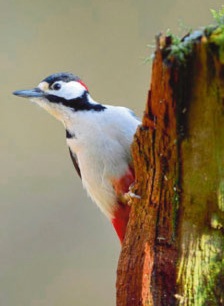
A good two-hour drive east of Zabola, in the Făgăraş Mountains, precisely this vision of the FCC is taking shape. Christoph Promberger, co-founder of the foundation, accompanies a small group ona narrow path into the Strâmba Valley. 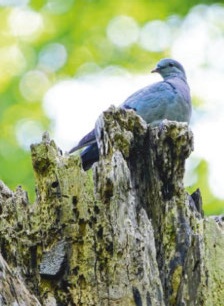 The air is humid, the light subdued. Every now and then, the callor tapping of a black woodpecker can be heard. Here, on the northeastern edge of the mountains, lies a piece of genuine primeval forest-part of the UNESCO World Heritage Site since 2017 “The Făgăraş Mountains, with over 200,000 hectares, are the largest contiguous forest and alpine region in Romania. It’s probably the wildest piece of landscape we still have in Central Europe,” says Promberger. According to the FCC’s plans, the largest national park in Europe, almost as large as the entire Ruhr region, is to be created here.
  Walking alongside Promberger is Gheorghe – Roman, a forester in the Strâmba Valley. “I manage 1,400 hectares here, 350 hectares of which are strictly protected primeval forest,” says the Romanian with visible pride. Anyone hiking here immediately notices the difference to the managed forests we know from Central Europe. Nothing looks tidy; no forester has drawn lines. The very chaos of fallen trunks and sprouting saplings shows what a forest looks like when it has been left to its own devices for centuries.
Promberger came to Romania as awolf researcher back in the 1990s. The native Bavarian repeatedly bends over the decaying tree trunks lying around: “When an old tree dies, it often remains standing for another 60 or 70 years. During this time, it provides food for countless insects. After that, it falls over, a clearing is created, and young trees immediately sprout in its place. A tree like this creates habitat for up to 100 years, even – in death.” Promberger taps a piece of wood into which woodpeckers have hammered their cavities. “Deadwood is the foundation of the forest. First come the fungi, then the beetles,then the woodpeckers. Owls or stock doves later move into their cavities. If you remove the deadwood, the whole system begins to suffer.” The explanation is also a plea against the excessive and often illegal logging that Promberger and his foundation are fighting in Romania.
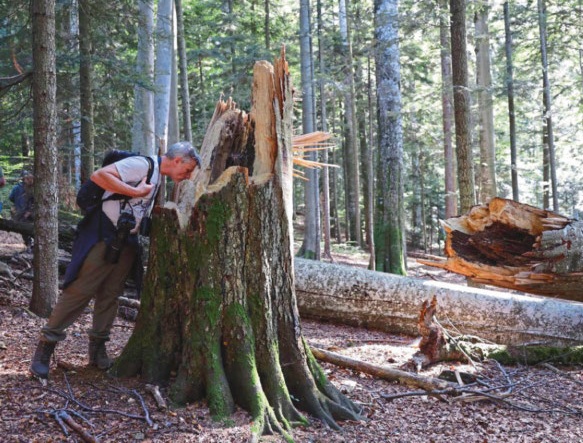 A few steps further on, the path leads through a research area. Each trunk is numbered, and its age has been determined by drilling. One fir tree, for example, is 250 years old. “Here, the researchers measured 1,500 cubic meters of wood per hectare. In a managed forest, you’ll only find 300 to 400 cubic meters. Even the oldest commercial forests reach a maximum of 800. Here we have almost double that, and five times as much as average,” explains Promberger. Such comparisons make it clear that primeval forests are not only older and Christoph Promberger explains the importance of deadwood.
They are more beautiful – they are also more useful. Every additional cubic meter of wood means stored energy, bound CO,₂, habitat for species that have long since disappeared from managed forests. Then Promberger looks up. “In the last three years alone, 300,000 trees older than 150 years have been felled in the Fågăraş Mountains. And the tragic thing is: the older the tree, the more likely it is to end up as firewood.” For Promberger, it is clear: in order for the forest to be preserved, this must also be economically justified. And that seems possible, because even now the protected forests generate more revenue than commercial foreststhrough entrance fees, guided tours, and local added value.
But the argument of “water” carries even more weight: “The Făgăraş Mountains make up only one percent of Romania’s territory but provide drinking water for 20 percent of the population. If Bucharest one day finds itself without water because nothing is stored up here anymore, perhaps people will understand what these forests are worth,” the expert warns. A World Bank study shows that a minimal levy of seven cents per 1,000 liters would be sufficient to finance the entire protection of the Carpathian forests, including compensation for forest owners. The fact that firewood often counts for – more than a millennia-old ecosystem seems absurd at this moment. Standing among the massive trunks, it becomes clear how little our short-term profits have to do with the value of such forests-and how great the responsibility is to preserve them.
With his wife Barbara, Promberger founded FCC in 2009, always keeping in mind the goal of creating the largest national park in Europe. Over 150 employees are now working for the organization: for reforestation, against poaching, and for the return of beavers and bison. Through its subsidiary, Travel Carpathia, the foundation brings guests into the forests. To show that tourism can be a long-term alternative for people’s incomes and an opportunity for the region.
But nature conservation is not only revealed in numbers, calculations, and international studies. Anyone who wants to understand what is at stake must experience the mountains with their own senses.
Right in the middle of it, not just on the sidelines The next morning, the journey continues with nature guide Oana Harabagiu up into the high mountains, to the Comisu hut on the slope of the mountain of the same name at an altitude of more than 1,800 meters – to where wilderness becomes tangible and bison, wolves and lynxes leave their traces The path climbs steadily through damp mixed forest, where the light filters through the canopy and mixes with the humid air – it rained during the night. A little further on, Harabagiu points to the trunk of a spruce tree, against which a large, furry animal has apparently been rubbing itself. The bark is rough and covered in resin; remnants of fur cling between the scratch marks. The thought that bears actually live somewhere among these trees changes one’s perception: the sounds seem louder, every shadow takes on weight. Harabagiu leads the way, bear spray made of hot capsicum readily available on her belt in case of emergency. A reassuring thought. Because even if the bears are usually peaceful, they are wild animals. The nature lover has never had to defend herself against the big brown ones, but she has against aggressive livestock guardian dogs.
Oana Harabagiu lives for nature. Remnants of fur and scratch marks give her clues about bears. She comes from Bucharest, leaving behind city air and routine to live out here. not because it’s easier, but because she understands the mountains like other people understand road maps. “I do this job because I love being outdoors,” she says. “And because I believe we’ve lost touch with nature. I wish more people, and more children, would go back outside and reconnect with it.”
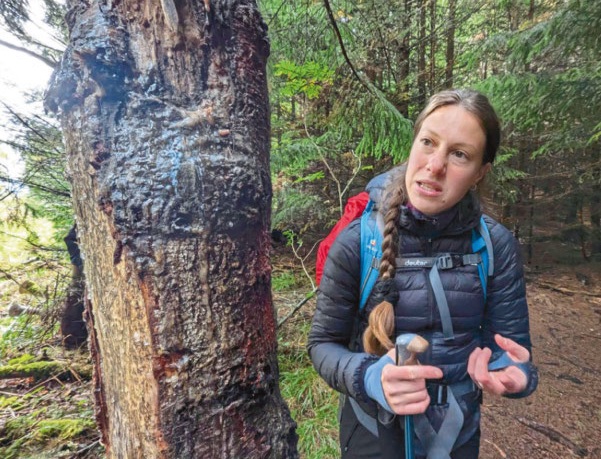
Harabagiu stops frequently, pointing out the subtle differences between spruce and fir, between needles that prick and those that are soft. She speaks in a subdued voice about forest ownership and responsibility, about protection that only works if it includes people. Then she points to a bare patch on the slope: “The law says that after clear-cutting, reforestation must take place within three years,” she says, “but often that doesn’t happen where the trees were felled.”
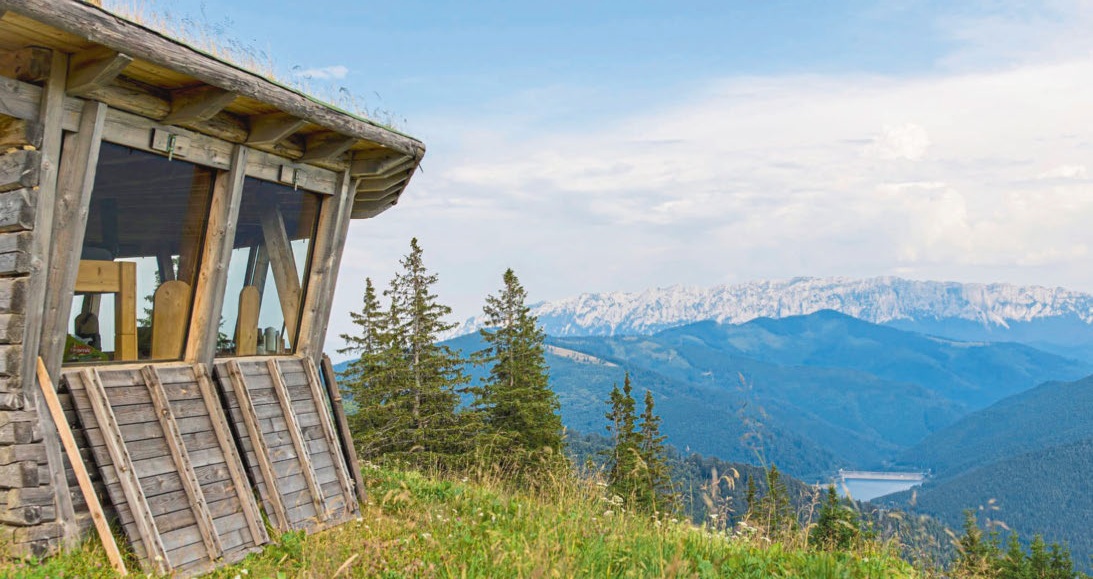
Beyond lies a meadow like a green cloth between the mountains. At its edge stands Comisu’s smallwildlife observation hut, barely larger than a stable. Overgrown with grass, it is almost one with the landscape. A little higher up is a second building, simple and rectangular: the night quarters. In the evening, wood glows in small stoves. In the older Comisu hut, we sit behind the panoramic windows. No cell service, no electricity, only the crackling of the fire in the stove. No animals yet appear, but in the twilight, the idea of seeing the unseen begins to take shape.
The next morning, finally, confirmation with our own eyes: A bison steps out of the shadows at the edge of the clearing. Heavy, blackish-brown, almost silent-a remnant of that wildness which had almost disappeared in Europe. The giant grazers. They also reached the Făgăraş Mountains in 2019, when animals from Poland, Germany, and Sweden were released here. All bison existing in Europe today descend from just twelve individuals-the only ones that survived after World War II. Now, around 100 bison live here again, distributed across valleys and alpine pastures. “They create open areas-that’s important for forest regeneration,” says Harabagiu. This creates meadows and habitats for insects, birds, and young trees. At the old gate where the first animals were released, she recounts how skeptical the initial reaction was: “Many thought the bison would destroy everything-fields, fences, gardens. Only when people saw that nothing bad was happening did they begin to ask where they could see them.”